NEET 2026 Counselling Complete Guide: MCC & UP Counselling Process, Fees, Documents, Rounds & Mistakes to Avoid
Complete NEET 2026 counselling guide covering MCC (All India) and UP counselling — registration, fees, documents, round-wise rules, seat matrix, and the costly mistakes students must avoid
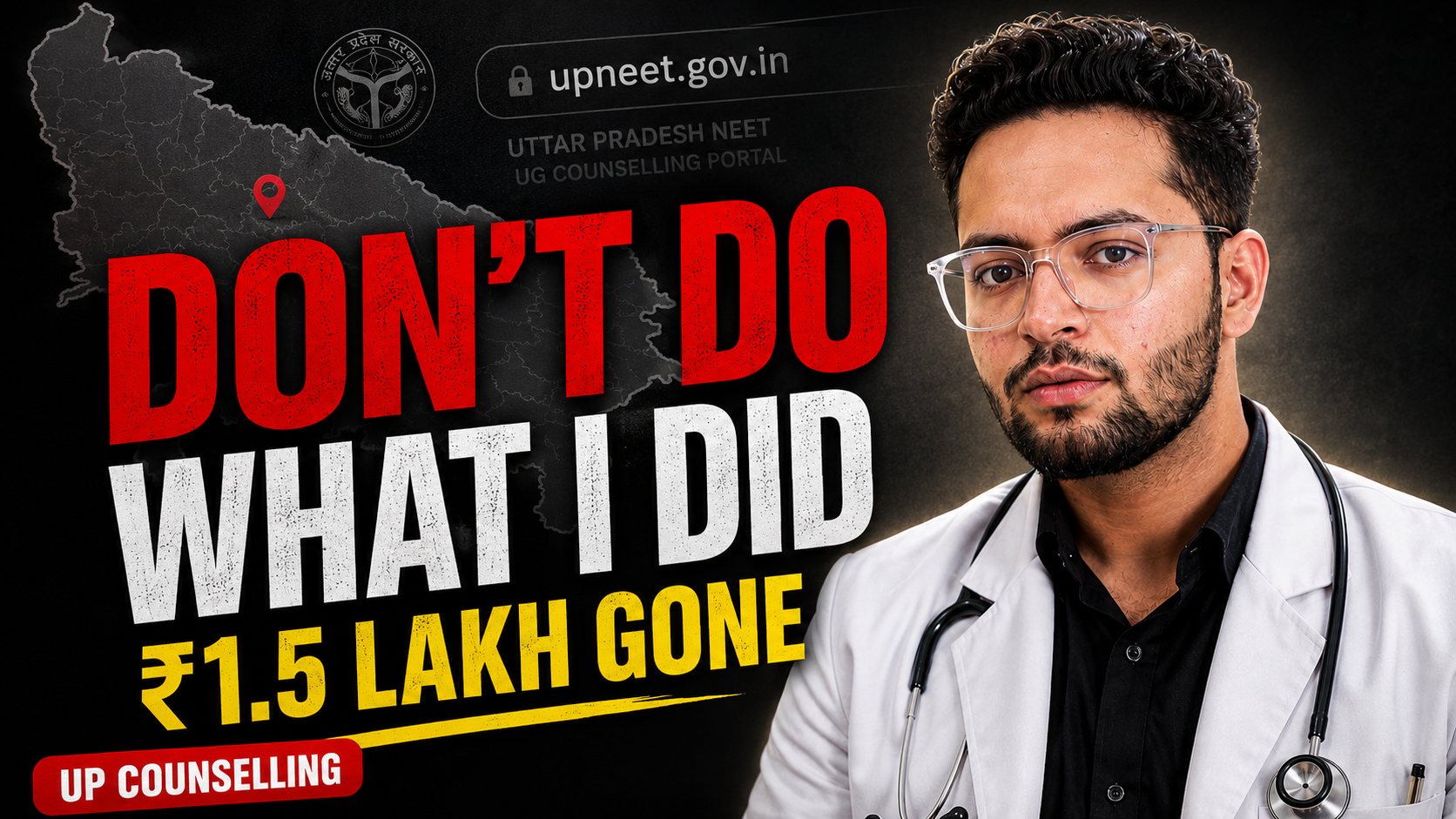
NEET result aane ke baad sabse confusing aur sabse important phase shuru hota hai — **counselling**. Har saal lakhs of students sirf isliye apna dream college miss kar dete hain kyuki unhe counselling ka process, rounds, fees, aur documentation properly samajh nahi aata.
Is guide mein hum cover karenge:
- MCC (All India Counselling) ka complete process, fees aur rounds
- UP State Counselling (upneet.gov.in) ka complete process, fees aur rounds
- Dono ke liye required documents
- Round-by-round rules — kab exit free hai, kab deposit forfeit hota hai
- Common mistakes jo students karte hain aur unka real cost
Chahe aap All India Quota target kar rahe ho ya UP State Quota, ye guide aapko har step explain karega.
---
What is NEET Counselling? MCC vs State Counselling
NEET qualify karne ke baad, MBBS/BDS seats do levels par counselling ke through allot hoti hain:
1. MCC Counselling (Medical Counselling Committee) — All India level, conducted via mcc.nic.in
2. State Counselling — har state ka apna counselling board, jaise UP ke liye upneet.gov.in (DGME-UP)
Government medical colleges mein seats is tarah divide hoti hain:
15% All India Quota (AIQ): Koi bhi state ka NEET-qualified student apply kar sakta hai, domicile zaroori nahi. AIIMS, JIPMER, BHU, AMU, DU aur Deemed Universities ki seats isi quota se bharti hain.
85% State Quota: Sirf us state ke domicile holders ke liye reserved.
Best outcome ke liye, students ko dono — AIQ aur apne state ka quota — alag-alag apply karna chahiye, kyuki dono ka process aur timeline thoda alag hota hai.
Beyond MCC and state DMET bodies, two other councils handle other courses:
VCI — Veterinary courses
AACCC — AYUSH courses (BAMS, BHMS, etc.)
---
Part 1: MCC Counselling (All India Quota) — Complete Process
MCC Seat Distribution: Which Colleges Fall Under MCC?
AIIMS, JIPMER, BHU: 100% seats filled directly via MCC.
Government medical colleges (state-run): Only the 15% AIQ seats go through MCC; the remaining 85% is filled via state counselling.
Central Universities (DU, IPU): 15% AIQ via MCC; the 85% State Quota is reserved for Delhi-schooled candidates and handled separately.
AMU (Aligarh Muslim University): MCC only forwards registered names — AMU itself verifies eligibility and manages its internal quota.
JMI (Jamia Millia Islamia): MCC conducts the counselling process, but JMI applies its own reservation policy.
AFMC Pune: MCC registers candidates and forwards names; AFMC then runs its own screening, interview, and medical fitness test before final selection.
ESIC Colleges: 15% of seats are reserved for wards of insured persons, and a valid ESIC card is required to claim this.
Deemed Universities: Autonomous institutions — no domicile requirement, no standard SC/ST/OBC reservation, though some offer minority quota seats.
AIQ Reservation Breakdown
Within the 15% All India Quota, reservation is structured as:
SC: 15%
ST: 7.5%
OBC: 27%
EWS: 10%
PwD: 5%
MCC Registration Process
1. Visit the official website — mcc.nic.in only. Fake/duplicate websites are common during counselling season; always verify the URL.
2. Register using the same mobile number and email ID used during the NEET application form. Do not change these during the process.
3. Pay the registration fee (see fee structure below).
4. Fill choices — list as many colleges as you want, with your genuine "dream college" at the top regardless of how competitive it is.
5. Wait for result, then report to the allotted college within the given window with all required documents.
MCC Counselling Fee Structure
General category: ₹1,000 non-refundable registration fee + ₹10,000 refundable security deposit.
SC/ST/OBC/PWD: ₹500 non-refundable registration fee + ₹5,000 refundable security deposit.
Deemed Universities: ₹5,000 non-refundable registration fee + ₹2,00,000 refundable security deposit.
The refundable deposit is adjusted into college fees upon joining (for deemed universities) or returned upon valid exit — but forfeited if you're allotted a seat from Round 2 onward and don't join.
MCC Counselling Rounds — Detailed Rules
Round 1
- Free exit allowed — if you don't join your allotted college, your deposit is safe.
- You can accept your Round 1 seat AND simultaneously opt for upgradation in Round 2.
Round 2
- No fresh registration needed if you already registered in Round 1.
- Penalty: If allotted a seat and you don't join, your security deposit is forfeited.
- If you successfully upgrade from your Round 1 seat, you must resign that seat — you cannot go back to it.
Round 3 (Mop-up Round)
- Fresh registration required only if you didn't register earlier, or didn't report to a previously allotted college.
- Strict rule: No exit allowed. If allotted a seat, you must join. Refusing forfeits your deposit and removes you from further counselling. No upgradation possible after this round.
Stray Vacancy Round
- Runs for seats that remain vacant after all earlier rounds — typically conducted offline, requiring physical presence at the college.
- Only candidates holding no seat anywhere (AIQ or State) are eligible.
- Joining is mandatory if allotted. Refusal forfeits your deposit and may result in a ban from future NEET counselling.
MCC Required Documents
- NEET Admit Card
- NEET Scorecard / Rank Letter
- 10th Certificate (for Date of Birth proof)
- 12th Certificate
- Aadhaar Card (or Passport / Voter ID)
- 8 passport-size photographs
- Seat Allotment Letter (printout)
- Category/Caste Certificate (if applicable — OBC-NCL must typically be issued on or after April 1 of the admission year)
- Sub-caste certificate (if required)
- OCI Card (for foreign/OCI candidates)
Important: All documents must be original and genuine. Submitting fake or forged documents can lead to legal action and disqualification.
---
Part 2: UP NEET Counselling (State Quota) — Complete Process
UP counselling is conducted by DGME-UP via the official portal upneet.gov.in, and governs the 85% State Quota seats reserved for UP-domicile candidates, along with state-specific institutes.
UP Counselling: Step-by-Step Process
1. Online Registration: Log in at upneet.gov.in using your NEET roll number and pay the non-refundable registration fee.
2. Security Deposit: This is the most crucial financial step — without paying it, the portal will not unlock choice filling.
3. Document Verification: Largely online now, though nodal centers still handle final checks at the reporting stage.
4. State Merit List: DGME-UP releases a UP-specific merit list based on NEET scores for registered candidates.
5. Choice Filling: Select preferred colleges in true preference order — top-tier dream colleges first, regional/backup options after, based on rank and quota.
6. Choice Locking: Manually lock your final order. The system has an auto-lock failsafe for the last day, but relying on it is risky since server load near deadlines is common.
7. Seat Allotment & Reporting: The algorithm assigns a seat based on rank, category, and preference order. Download the allotment letter and physically report to the nodal center/college to confirm admission.
UP Counselling Fee Structure
- Government MBBS: Security deposit of approximately ₹30,000 (refundable).
- Government BDS (Dental): Security deposit of approximately ₹1,00,000 (refundable).
- Private MBBS/BDS: Security deposit of approximately ₹2,00,000 (refundable).
This is significantly higher than MCC's deposit structure, which is exactly why round-wise exit mistakes are far costlier in UP counselling than in All India counselling.
UP Counselling Documents Checklist
Basic Educational Certificates
- 10th Class Certificate (Date of Birth confirmation)
- 12th Class Marksheet (verifies minimum 50% PCB eligibility)
- School Leaving / Transfer Certificate
- Migration Certificate (if previously enrolled in another university, e.g., a BSc program)
Identification & Quota Documents
- UP Domicile Certificate (compulsory for State Quota; criteria vary — some regions require a Nativity Certificate instead)
- NEET Application Form Confirmation Page
- NEET Admit Card & Scorecard
- Category Certificate (EWS/OBC/SC/ST):
- EWS certificate must be issued after April 1 of the admission year
- OBC requires **separate Central and State certificates** — Central for AIQ, State for UP counselling; expired ones must be renewed via Tehsildar/SDM
- Special Quota Certificates if applicable (minority quota, PwD, ESIC, Defense quota)
Affidavits & Additional Certificates
- Gap Certificate/Affidavit (required if there was a year-or-more gap after 12th for NEET preparation; usually on ₹100 stamp paper)
- 8 passport-size photographs (same as used in NEET registration)
- Valid ID Proof (Aadhaar, Driving License, Passport, or Voter ID)
- Allotment Letter (downloaded after seat allocation)
- Character Certificate (must not be older than 6 months)
Tip: Keep originals, photocopies, and soft copies of every document ready before reporting day.
UP Counselling Rounds & What Happens If You Don't Join
- Round 1: Free exit allowed — no penalty, your deposit stays safe.
- Round 2: No free exit — if you don't join an allotted seat, your security deposit is forfeited (up to ₹2 lakh for private colleges).
- Mop Up Round: No exit allowed — refusing an allotted seat means forfeiture, and you're likely removed from further counselling.
- Stray Vacancy Round: Joining is mandatory if you're allotted a seat — refusal means forfeiture plus being barred from further rounds.
This mirrors MCC's broad structure (Round 1 safe, Round 2 onward risky) — but because UP's deposit amounts are so much larger, the same mistake costs students far more money in state counselling than in MCC.
---
Common Counselling Mistakes Students Make (And the Real Cost)
Based on real experiences from students who've been through this process, here are the most expensive and avoidable mistakes:
1. Not taking the security deposit seriously. Assuming you can simply skip joining a Round 1 seat to "wait for something better" in Round 2 without understanding that Round 2 has no free exit — this single misunderstanding can cost up to ₹2 lakh in UP private college counselling.
2. The category/domicile certificate trap. UP counselling is strict about documentation timelines. An OBC or EWS certificate that isn't freshly issued (generally post-April 1 of the admission year) gets rejected instantly, and the candidate is auto-shifted to the General category — losing access to the quota seat they were otherwise eligible for.
3. Filling choices blindly. The counselling algorithm reads your choice list top to bottom. Placing a "safer" college above your actual dream college — thinking it improves your odds — means the algorithm allots the safer one first and never even considers your dream college below it, regardless of your rank.
4. Relying on auto-lock. Government counselling portals frequently experience heavy traffic and server slowdowns near deadlines. Waiting for the system to auto-lock your choices instead of manually locking and saving a confirmation copy is a preventable risk.
5. Falling for "seat guarantee" agents. Be cautious of anyone promising a guaranteed seat for extra payment outside the official process — this is commonly fraudulent. Genuine counsellors who provide information and guidance (without guaranteeing outcomes) are a different, legitimate category.
6. Ignoring hidden costs at private colleges. When comparing a private college against a government college, tuition fee alone doesn't tell the full story — hostel fees, mess charges, AC charges, and university exam fees can add lakhs to the total cost over the course.
---
MCC vs UP Counselling: Key Differences at a Glance
- Official website: MCC uses mcc.nic.in; UP counselling uses upneet.gov.in.
- Eligibility: MCC is open to any NEET-qualified candidate nationwide; UP counselling requires UP domicile.
- Seats covered: MCC covers 15% AIQ plus 100% of AIIMS/JIPMER/BHU and Deemed Universities; UP covers the 85% State Quota plus state-specific institutes.
- General category security deposit: ₹10,000 for MCC vs approximately ₹30,000 (government) to ₹2,00,000 (private) for UP.
- Domicile certificate required: Not needed for MCC; mandatory for UP counselling.
- Round 1 exit: Free in both MCC and UP counselling.
- Round 2 onward exit: Forfeiture applies in both — but the absolute amount lost is much higher in UP due to its steeper deposit structure.
---
Frequently Asked Questions
Q: Can I apply for both MCC and UP counselling at the same time?
Yes. Students are advised to register for both All India Quota and their state quota counselling separately to maximize their chances of getting the best possible college.
Q: What happens if I don't join my allotted seat in Round 1?
In both MCC and UP counselling, Round 1 allows free exit without losing your security deposit.
Q: Is the UP counselling security deposit the same for all colleges?
No. It varies by college type — approximately ₹30,000 for government MBBS, ₹1,00,000 for government dental, and ₹2,00,000 for private MBBS/BDS seats.
Q: My OBC certificate is from last year — will it work?
Likely not. UP counselling generally requires category certificates (OBC/EWS) to be freshly issued, typically on or after April 1 of the admission year. An outdated certificate usually results in automatic rejection and a shift to the General category.
Q: What is the Stray Vacancy Round?
It's the final round for seats that remain vacant after all earlier rounds, conducted offline and only open to candidates who hold no seat anywhere. If a seat is allotted in this round, joining is mandatory.
Q: Are counselling agents who guarantee a seat legitimate?
Be highly cautious of anyone guaranteeing a specific seat in exchange for extra payment — this is a common fraud pattern. Legitimate guidance services provide information and college data but cannot and do not guarantee outcomes, since allotment is algorithm-driven based on rank, category, and choices filled.
---
This guide is based on the NEET 2026 counselling process as explained in detail on the Doctor Areeb YouTube channel. For step-by-step video walkthroughs of registration, choice filling, and round-wise strategy, subscribe to the channel.