How to Pass MBBS 1st Year in 30 Days: The Ultimate Last-Minute Survival Guide
A practical 30-day survival plan to pass MBBS 1st Professional exams using PYQs, flowcharts, and AI prompts — from Areeb.
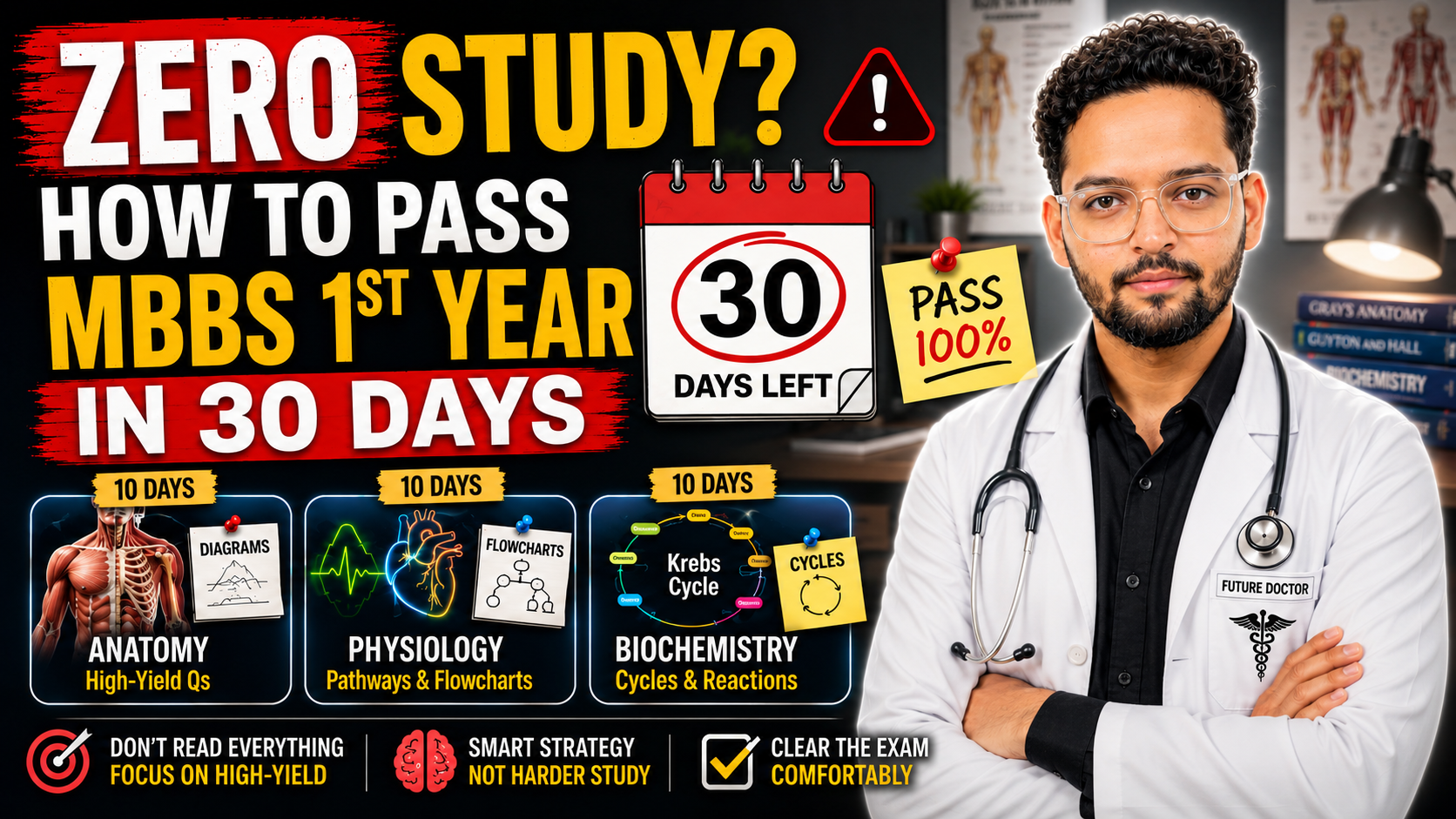
Zero Study? How to Pass MBBS 1st Year University Exams in 30 Days (Complete Survival Guide 2026)
Prompts for all if you are coming from YouTube
AI can dramatically speed up answer preparation. Try a prompt like:
Anatomy
“Generate a 50-mark MBBS university answer on the [Topic]. Include introduction, classification, labelled diagram, flowcharts, clinical importance, and in examiner-friendly format to fetch full marks without error and use standard textbook latest edition.”
Physiology
“Generate a 50-mark MBBS university answer on the [Topic]. Include introduction, classification, labelled diagram, flowcharts, clinical importance, and in examiner-friendly format to fetch full marks without error and use standard textbook latest edition.”
Biochemistry
“Generate a 50-mark MBBS university answer on the [Topic]. Include introduction, classification, labelled cycle, flowcharts, clinical importance, and in examiner-friendly format to fetch full marks without error and use standard textbook latest edition.”
📺 Watch the full video breakdown here:How to Pass MBBS 1st Year Exams in 30 Days
If you’re staring down your MBBS 1st Professional University Exams with barely 20–40 days on the clock and the syllabus still mostly untouched — don’t panic. You’re not the only one, and you’re not doomed.
This isn’t a guide to becoming a topper. It’s a practical survival strategy to help MBBS students clear their 1st-year exams by focusing only on high-yield topics, previous year questions (PYQs), flowcharts, and exam-oriented answer writing — not endless lecture-watching.
This approach has helped countless students go from panic mode to passing mode. Here’s exactly how to do it.
Who This Guide Is For
This 30-day plan is built for you if:
- You have 20–40 days left before your exams
- You haven’t completed the syllabus
- You feel overwhelmed by Anatomy, Physiology, and Biochemistry
- You don’t know where to even start
- Your goal is to pass and avoid a supplementary exam — not top the batch
If you still have 4–6 months left, this isn’t the right method for you yet — save it for when the crunch actually hits.
Table of Contents
- Who This Guide Is For
- The 30-Day MBBS Master Plan
- Anatomy Strategy
- Physiology Strategy
- Biochemistry Strategy
- The Golden Rules
- Free AI Prompt Library
- Frequently Asked Questions
- Final Thoughts
The 30-Day MBBS Master Plan (Subject-Wise Breakdown)
Instead of juggling all three subjects together, split your prep into three focused 10-day blocks.
Days 1–10: Anatomy
Anatomy is memory-heavy and needs repeated revision, so tackle it first while your motivation is highest.
Focus on:
- Important long questions
- Frequently asked university questions
- Diagrams
- Flowcharts
- Clinical correlations
Skip trying to finish entire video courses start to finish — there isn’t time, and it isn’t the highest-yield use of your remaining days.
Days 11–20: Physiology
Physiology is usually the fastest subject to wrap up, since a lot of it overlaps with Class 11–12 Biology.
Focus on:
- Flowcharts
- Mechanisms
- Definitions
- Important diagrams
- Long-answer pathways
Examiners consistently reward organized, flowchart-based answers over dense paragraphs.
Days 21–30: Biochemistry
Save Biochemistry for last. Metabolic cycles are volatile — if you learn them too early, they fade by exam day.
Focus on:
- Glycolysis
- TCA Cycle
- Urea Cycle
- HMP Shunt
- Lipid Metabolism
- Vitamins
- Important clinical biochemistry questions
Draw the cycles repeatedly rather than just reading them.
Anatomy Strategy: Study Smart
Stop Watching Endless Lectures
With 30 days left, you don’t have time to finish Marrow, PrepLadder, PW, Unacademy, or long YouTube playlists end to end. You need active preparation, not passive consumption.
Use Previous Year Questions (PYQs)
Track down:
- University PYQs
- Important question PDFs
- Bhalani Sir lists
- College-specific question banks
These already contain most of the repeat questions that show up year after year.
The ChatGPT Method for Anatomy Answers
AI can dramatically speed up answer preparation. Try a prompt like:
“Generate a 50-mark MBBS university answer on the [Topic]. Include introduction, classification, labelled diagram, flowcharts, clinical importance, and in examiner-friendly format to fetch full marks without error and use standard textbook latest edition.”
This instantly gives you a structured answer. Then:
- Convert it into your own notes
- Practice writing it out
- Learn the diagram
This single trick saves enormous amounts of time during exam crunch.
Physiology Strategy
Physiology rewards understanding over memorization. You don’t need to learn every line — you need to learn the logic.
Focus on:
- Flowcharts
- Mechanisms
- Graphs
- Definitions
Priority systems:
- Cardiovascular System
- Respiratory System
- Renal System
- Endocrine System
- CNS
Pairing tip: Don’t stack two heavy systems on the same day.
❌ Avoid: CNS + CVS, Renal + CNS ✅ Instead: CNS + Blood, CVS + Endocrine
AI can dramatically speed up answer preparation. Try a prompt like:
“Generate a 50-mark MBBS university answer on the [Topic]. Include introduction, classification, labelled diagram, flowcharts, clinical importance, and in examiner-friendly format to fetch full marks without error and use standard textbook latest edition.”
Biochemistry Strategy
Most students fear Biochemistry purely because of the memorization load. The fix is repetition, not more reading.
High-yield topics to memorize:
Cycles
- Krebs Cycle
- Urea Cycle
- Glycolysis
- HMP Shunt
Vitamins
- Vitamin A
- Vitamin D
- Vitamin B12
- Vitamin C
Clinical Topics
- Diabetes Mellitus
- Jaundice
- Liver Function Tests
- Protein Energy Malnutrition
AI can dramatically speed up answer preparation. Try a prompt like:
“Generate a 50-mark MBBS university answer on the [Topic]. Include introduction, classification, labelled cycle, flowcharts, clinical importance, and in examiner-friendly format to fetch full marks without error and use standard textbook latest edition.”
Write it, don’t just read it. Take a blank page and repeatedly draw out cycles, pathways, and flowcharts from memory. This is the single biggest lever for retention in Biochemistry.
The Golden Rules for Your Last Month of MBBS Prep
Rule 1: Stop Making Fancy Timetables Minute-by-minute schedules fail under pressure. Set chapter goals instead — “Finish Upper Limb today, Blood tomorrow.” Simple, effective, realistic.
Rule 2: Prioritize Output Over Input Most students spend 80% of their time watching and 20% revising. Flip it. Successful students spend roughly 20% learning and 80% writing. University exams reward what you can produce on paper, not what you’ve watched.
Rule 3: Practice Diagrams Daily Diagrams save marks. Practice these daily:
- Anatomy: Brachial Plexus, Neuro anatomy and head and neck diagrams
- Physiology: Cardiac Cycle, Nephron, Respiratory graphs
- Biochemistry: TCA Cycle, Urea Cycle, Glycolysis
Rule 4: Don’t Chase Perfection Your goal isn’t “complete every page” — it’s “score enough marks to pass comfortably.” Stay ruthlessly focused on high-yield content.
Free AI Prompt Library for MBBS Students
Copy and adapt these directly:
- “Generate a 50-mark MBBS university answer on [TOPIC] with headings, flowcharts, diagrams to draw, clinical importance and conclusion.”
- “Act as an MBBS examiner. Give me the most frequently asked university questions from [Chapter/Unit].”
- “Convert this chapter into a one-page revision sheet for MBBS university exams.”
- “Give me the top 20 viva questions from [TOPIC] with concise answers.”
Frequently Asked Questions
Q1. Can I really pass MBBS 1st year in 30 days with zero study?
Yes, if your goal is to pass — not to top your batch. A focused 30-day plan built around previous year questions, flowcharts, and high-yield topics can get you through 1st Professional exams even from a near-zero starting point. This method isn’t designed for ranking; it’s designed for clearing the exam and avoiding a supplementary.
Q2. Is 30 days enough to cover Anatomy, Physiology, and Biochemistry?
It’s enough if you split the time into focused 10-day blocks per subject and prioritize PYQs and diagrams over watching full lecture courses. You won’t cover every topic in depth, but you don’t need to — you need to cover the topics that actually appear in university papers.
Q3. What if I haven’t touched Biochemistry at all?
That’s actually fine, since Biochemistry is recommended last in this plan anyway. Metabolic cycles like Glycolysis, the TCA cycle, and the Urea cycle are easy to forget if learned too early, so starting them in your final 10 days works in your favor rather than against you.
Q4. Should I keep watching lecture videos (Marrow, PrepLadder, Unacademy) during these 30 days?
Not as your primary strategy. With limited time, full video courses cost more time than they return. Use lectures only to clarify a specific concept you don’t understand — your main time should go toward PYQs, writing practice, and diagrams.
Q5. Which subject should I start with first?
Anatomy. It’s the most memory-heavy subject and benefits most from early, repeated revision while your motivation and energy are highest. Save Biochemistry for last since its content is the most volatile in memory.
Q6. How many hours a day should I study during this 30-day plan?
This guide intentionally avoids hour-by-hour timetables, since rigid schedules tend to collapse under pressure. Set daily chapter goals instead — for example, “finish Upper Limb today” — and let your study hours flex around getting that goal done.
Q7. Can I use ChatGPT or AI tools to prepare answers faster?
Yes — this is one of the core strategies in this plan. Structured prompts can generate exam-formatted answers (with diagrams, flowcharts, and clinical correlations) in seconds, which you then convert into your own notes and practice writing by hand. The prompt library above has five ready-to-use examples.
Q8. What’s the single biggest mistake students make in their last month before exams?
Spending too much time watching and too little time writing. Most students put in roughly 80% input (watching/reading) and 20% output (writing/practice) — successful last-minute preparation flips that ratio toward 80% active writing and recall.
Final Thoughts
Final Thoughts
Every year thousands of MBBS students find themselves in the same situation—30 days left, an unfinished syllabus, and panic setting in.
The truth is that university exams do not reward students who consume the most content. They reward students who can reproduce structured answers, draw diagrams, write flowcharts, and present information in an examiner-friendly format.
If you focus on previous year questions, high-yield topics, active recall, and answer-writing practice, 30 days can be enough to comfortably clear your MBBS 1st Professional examinations.
Remember:
You do not need to know everything. You only need to know enough to pass.
Start today. Stay consistent. Trust the process.
Your future doctor self will thank you.
🎥 Watch the complete video here:Zero Study? How to Pass MBBS 1st Year Exams in 30 Days
If this helped, check out more MBBS survival guides, study hacks, and exam strategies on Doctor Areeb — youtube.com/@areeb-mbbs.